


Metaverse mockery and skepticism is popular among ‘experts’, not in the least due to Meta’s latest cringe-worthy presentations. But there’s something to be learned from history.
Mark Zuckerberg and Meta did a terrible job. I almost couldn’t watch his pathetic avatar-self explain that the new avatars would be “more expressive and detailed than anything else today”. And that “the new avatars will also have legs, probably the most requested feature on our roadmap”. By then I was burying my face in my hands. “But seriously”, he said, “legs are hard, which is why other virtual reality systems don’t have them either” (he should take a good look at Somnium Space, but that is a bit beside my point).
One can hardly blame anyone for being utterly flabbergasted by such an awful performance from the company that claims to pour billions into Metaverse development. If you blend this with the Axie Infinity crash, and nosediving Metaverse virtual land prices, you see a Metaverse industry that is seemingly in deep trouble. Many see this as the perfect time to mock Metaverse projects and proclaim that the Metaverse is dead. And that’s a good thing some of those ‘experts’ tell us. Why would we want to live in the Metaverse in the first place?
I can’t help to think of the ‘slope of enlightenment’, where inflated expectations about new technologies are typically followed by a phase of disillusionment. But further down the road they lead to enlightenment and ultimately result in new tools for productivity. We’ve seen this time and time again. Thank god for innovators and pioneers who are not getting distracted by the cacophony of strong opinions by self-proclaimed and misguided experts.


I also can’t help to think about the skepticism back in the 90’s. I am talking about the Internet.
Hype alert: Why cyberspace isn’t, and will never be, nirvana. (Newsweek, 1995)

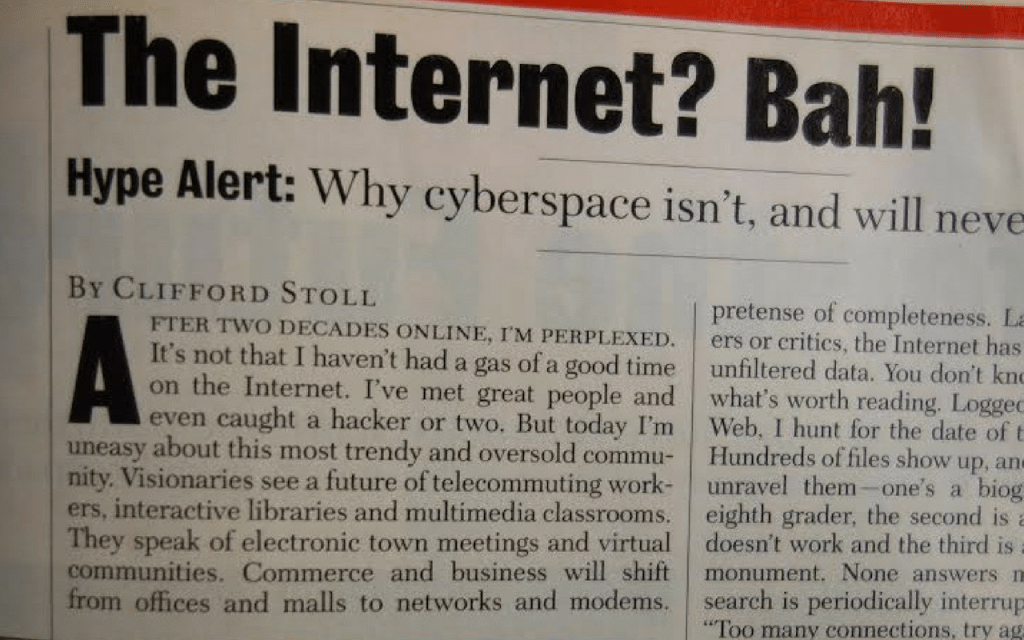
It’s very entertaining to read an old Newsweek article from 1995 (Hype alert: Why cyberspace isn’t, and will never be, nirvana.) It’s not that old if you think about it, but the world was fundamentally different back then. And so were peoples opinions about the Internet.
Here are a few excerpts.
Then there’s cyberbusiness. We’re promised instant catalog shopping–just point and click for great deals. We’ll order airline tickets over the network, make restaurant reservations and negotiate sales contracts. Stores will become obsolete.
So how come my local mall does more business in an afternoon than the entire Internet handles in a month?
Does this ring a bell? We’re not at the ‘mass adoption’ stage of the Metaverse. Active user counts are low. Since when has that stopped innovators and pioneers from pushing?
Even if there were a trustworthy way to send money over the Internet–which there isn’t–the network is missing a most essential ingredient of capitalism: salespeople.
Hilarious.
What’s missing from this electronic wonderland? Human contact. Discount the fawning techno-burble about virtual communities. Computers and networks isolate us from one another. A network chat line is a limp substitute for meeting friends over coffee.
Very similar to the popular ‘why would you want to spend time in the Metaverse?’ trope.
No interactive multimedia display comes close to the excitement of a live concert. And who’d prefer cybersex to the real thing?
I am not going to comment this.
The writer of this article is not very different from all those modern day YouTubers and commentators who think they have figured it all out. They all chant that the Metaverse is dead and gain more subscribers in the process.
Why the Metaverse will be as transformative as the Internet was (and is)
I do not have a crystal ball. It’s not that I have figured it all out. Of course there are many hurdles along the way, but the point is that progress is not dependent on how hyped or disillusioned people are, where exactly we are on the slope of enlightenment. Sure, money needs to be made eventually, but what we witness now is the development of a foundation which will fuel compounding and open ended creativity and present many new opportunities to those who are willing to dive in, just like the Internet did.
I am not daydreaming here. This is not something theoretical or hypothetical. I witness it daily in Somnium Space, an open, persistent virtual reality platform. It is like a giant sandbox allowing people to unleash their creativity. Already today they’re working on the applications of the future, in the form of amazing spatial experiences for socializing, learning, and doing business.
It is not a question of whether the Metaverse will transform peoples lives, but when.
But hey, let’s meet again in 25 years and make an hilarious compilation with the title ‘The Metaverse? Bah! How ‘Experts’ in 2022 Proclaimed the Metaverse was Dead’.
Where we meet?
In the Metaverse of course.