

Written by Marc Demar
When Somnium Space first teased the VR1, the promise was bold: a creator-grade, open, and relentlessly practical headset that could serve sim pilots, builders, performers, and everyday explorers without locking them into a walled garden. After following its development closely and putting it to work across Somnium’s social VR, creative tools, and mixed-reality use cases, I can say the VR1 delivers on what matters: clarity, openness, and genuine versatility.

The headline spec that reshapes everything is optical performance. The VR1 pushes 2,880 × 2,880 pixels per eye with a field of view up to ~130° horizontal and ~105° vertical – numbers that move you from “good for demos” to “good for living in.” Text legibility, cockpit gauges, distant signage, and fine-detail UI become far less of a compromise, which is exactly what creators and power users need if they’re building worlds, filming, scripting interactions, or flying high-fidelity sims.
Mixed reality isn’t an afterthought here – it’s a first-class capability. Dual 12-megapixel RGB passthrough cameras (4,056 × 3,040 each) make it practical to stay anchored to your physical setup while remaining immersed in virtual content. That’s a game-changer in Somnium’s creator workflows and a revelation for flight sim: adjust a physical throttle or flip a real-world switch while your brain is still “in cockpit.” Reviewers who tested MR with the VR1 noted just how clean and useful that passthrough feels in realistic lighting, and it maps perfectly to Somnium’s growing mixed-reality scene.
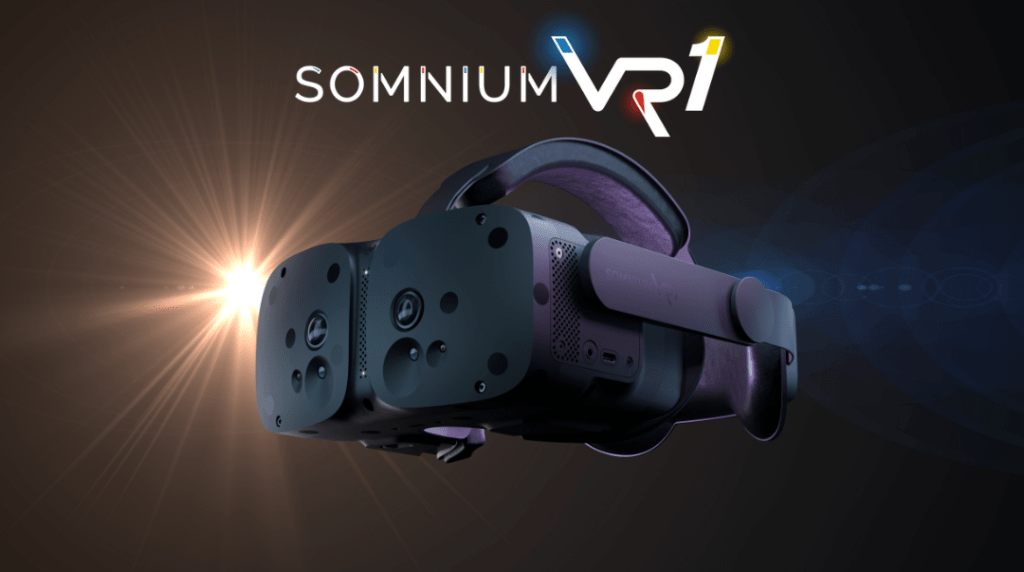
Tracking options are equally serious. Eye tracking runs at up to 120 Hz, allowing for single point calibration, while hand tracking (Ultraleap) brings reliable controller-free manipulation into play – especially helpful when you’re presenting, prototyping, or simply moving through UI with a lighter touch. The Ultimate Edition combines eye and hand tracking with mixed reality; the Visionary Edition focuses on eye tracking, while the Titan Edition has hand-tracking. All three keep the core optics and wide FOV intact. Importantly, the VR1 plays well with existing PC ecosystems: SteamVR and OpenXR compatibility keep you in control of the software you rely on.

Openness isn’t a slogan here; it’s a design choice. The VR1 embraces modularity with external anchor points and high-speed USB-C ports, inviting custom add-ons and maker-grade creativity. Somnium’s own development posts highlighted how the team prioritized those mount points so tinkerers and professionals could extend the headset instead of waiting for a new model. It’s exactly the mentality that built Somnium Space itself: give creators surface area to invent on.
Comfort matters when your sessions run hours, not minutes. Third-party support arrived quickly: Studioform’s dedicated accessories for the VR1 add counterbalances, straps, and comfort mods that spread weight and stabilize the fit. The result is a headset that scales from quick social drop-ins to long haul building, filming, or sim flying – without the inevitable “hot-spot” fatigue.
The hardware meets you where you work in VR. Somnium Space’s platform side is tuned for Unity creators who want to ship avatars, wearables, and fully interactive Worlds. The synergy is obvious: a high-fidelity, mixed-reality-capable headset paired with a platform that actually lets you monetize through items, wearables, and tipping – plus the freedom to script complex behaviors. If you’re treating VR as a medium (not just a game), this combo accelerates the entire pipeline from idea to experience.

And then there’s the “why now” question. The VR1 doesn’t chase novelty for its own sake; it solves the handful of constraints that keep immersive work from feeling professional: clarity you can trust, MR you can actually use, tracking that adapts to your session, and an ecosystem that doesn’t box you in. Pair it with Somnium’s open, creator-first economy and you have a stack that respects your time, your craft, and your business model. On that promise – the one that mattered most to me – the VR1 delivers.
About Somnium Space
Somnium Space, the company behind the VR1, also runs a blockchain-based virtual reality platform that allows users to create, experience, and monetize content and applications. The platform is committed to building a decentralized and immersive VR world that offers users a unique and engaging experience.
Discord: https://discord.gg/somniumspace
Authencity: https://authencity.io/user/somniumspace
Follow the Somnium Times
Authencity: https://authencity.io/user/SomniumTimes
YouTube: https://www.youtube.com/@SomniumTimes
Instagram: https://www.instagram.com/somniumtimes/




Leave a Reply