

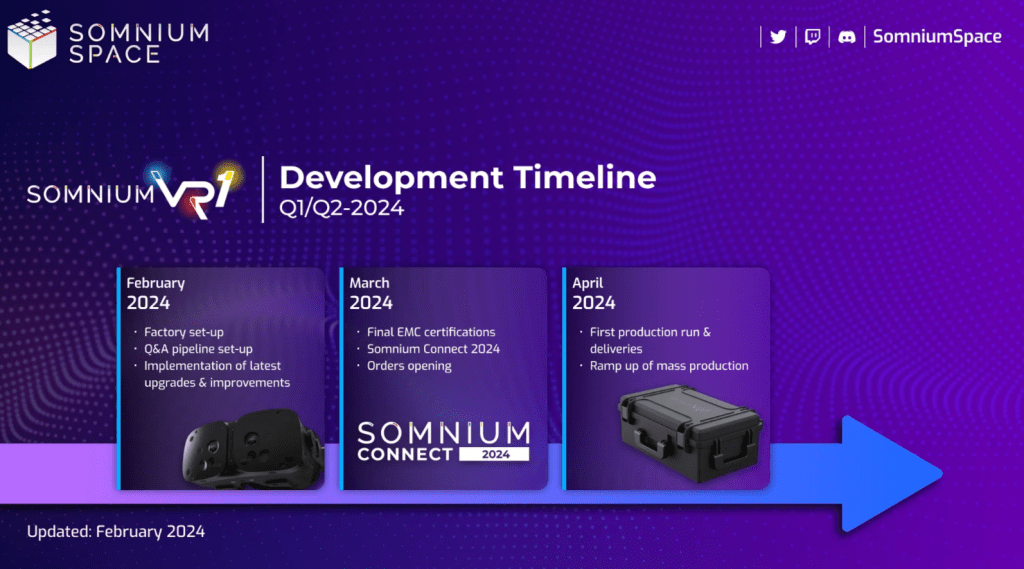
The most recent update for the Somnium VR1 has been released on Medium, and one aspect particularly caught my attention while reading through it. Somnium Space demonstrates a commitment to leaving no stone unturned, striving relentlessly to deliver the utmost quality. It’s reassuring to gain insights into the meticulous processes the company employs, from verification and re-verification to testing, fixing, and ensuring nothing is overlooked in the quest for improvement.
As we navigate these next two months, our focus remains on delivering a VR headset that embodies true innovation, outstanding quality, and an unparalleled user experience. — Artur Sychov, founder and CEO Somnium Space
The list of improvements since December of last year is extensive. I recommend reading the Medium post for a comprehensive view, but allow me to highlight a few noteworthy ones:
- Lens imperfections, as pointed out by some YouTubers, have been addressed.
- The IPD adjustment range has been expanded to 58–75.
- Significant enhancements have been made to the microphones.
- The facemask design has been substantially improved for comfort and an even wider horizontal FOV of up to 136 degrees.
- Testing is underway for a hardware fix known as Chromatic Aberration Total Annihilator (CATA).
- Strap improvements include enhanced rigidity, an added counterweight, and improved aesthetics.
- Work has begun on a 72Hz mode, which will be available upon launch.
Of particular note is the CATA, described by Artur Sychov as potentially the world’s first and most unique VR hardware feature for visuals.
It’s reassuring that Somnium Space allowed select YouTubers to test early versions of the VR1, despite imperfections such as manual assembly (including manual assembly of the optical stack) and uncoated lenses, in order to gather feedback on user experience. They have since made considerable efforts to address reported issues, and they will invite the same YouTubers to test the nearly final product. While we await the results of the second round of reviews, this process significantly bolsters confidence in the VR1 product.
While the VR1 may not be accessible to everyone due to its price tag, I believe it has a great future. Let’s recap some of the features that make this headset an enticing option for VR/MR enthusiasts:
- Designed and manufactured in the European Union.
- Exceptional brightness, FOV, clarity, and contrast.
- Modular design with 3D printable parts.
- Open-source with access to sensors.
- Not confined within a closed ecosystem (so called walled garden).
- Multiple variants available, including a ‘bad boy’ model with eye and hand tracking and mixed reality cameras.
- EU-based support infrastructure.
- Transparent practices from Somnium Space and its founder and CEO, Artur Sychov.
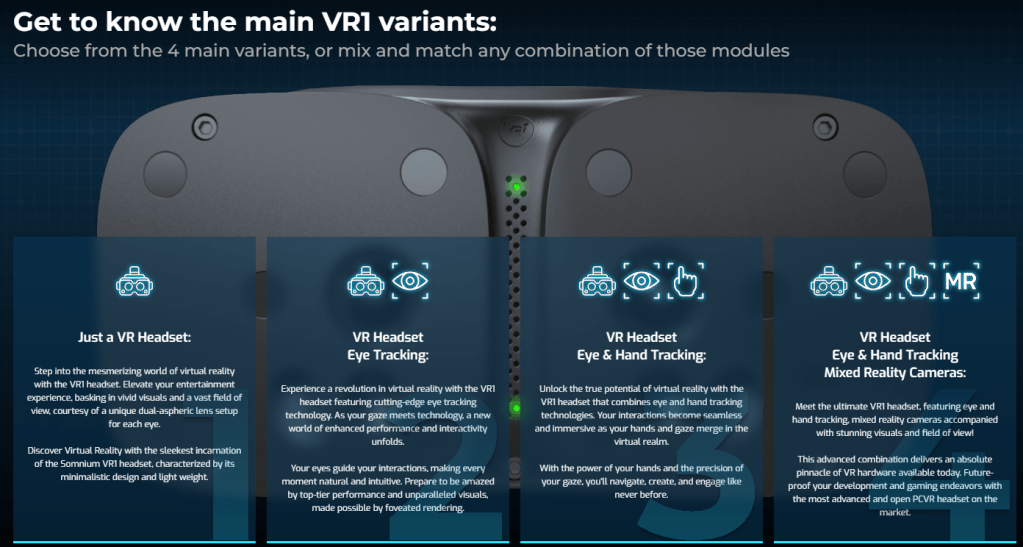
The four main variants of the Somnium VR1
Considering everything, I genuinely believe that the VR1 offers excellent value for its price. Regarding the price point, I appreciate and respect that the VR1 is not a subsidized device, unlike the Quest 3, for instance. There are no hidden motives, no attempts to draw me into a closed ecosystem and profit off me in the future (which is necessary for Meta to justify the Quest 3’s low price, despite its higher production costs compared to the $500 retail price).
I find that my values align with those of Somnium Space. Beyond its impressive technical specifications, they deliver a product of genuine quality and integrity that I trust will serve me well for many years to come. And I sincerely wish them continued success.
The time is near, according to the medium post orders will open for people who reserved their spot somewhere in March. First production and deliveries is planned for April.
Exciting times ahead!
By the way, you can still reserve your spot. Head over to the somniumspace.com website and click Reserve Your Spot.

Leave a Reply