



Written by sCessions
Scanning space and time, one space at a time
Trust me when I say VR experiences in Somnium Space leave an impression on your psyche that changes you in some form or another. Memories are forever, but when we talk about the past all we have are fleeting moments that fade over time. Terry Kilby takes what is considered a past memory and brings it into the present. Mr. Kilby has been a long-time advocate of using aerial photography and 3D scans, obtaining real-world moments in history essentially creating past coordinates for future time-travel.
For example: The “Berlin Wall – Mauerpark Scan” (the Berlin Wall was built in 1961) and the “General Lee Monument” from North Carolina (created in 1890); have opened discussions in 2020 of racial indifference, oppression, and degradation.
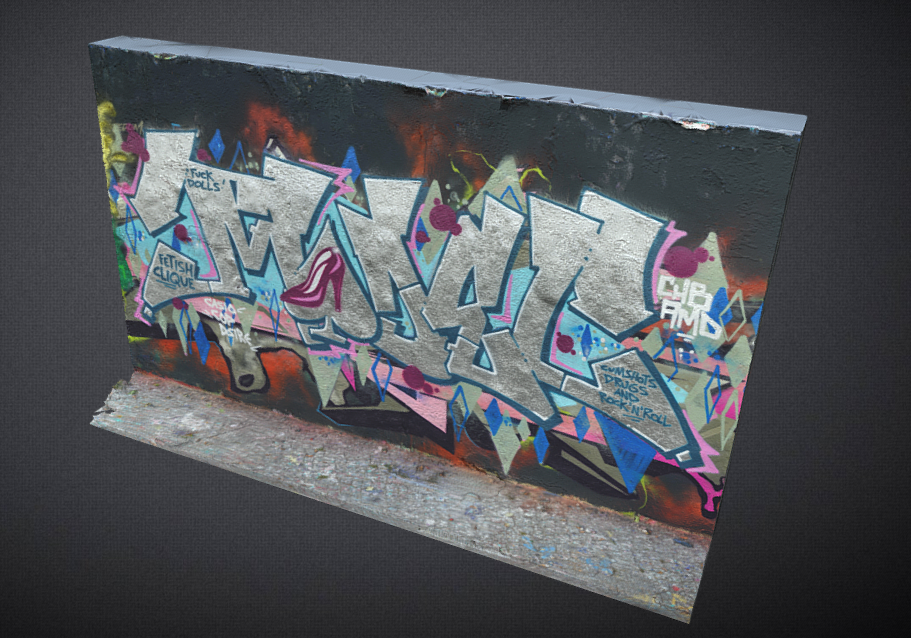
“I honestly believe that some of our nation’s most cherished historical artifacts of the future will include 3D captures of transitional moments taking place around us right now.” -Kilby
Scalpel LiDAR Scanner
What would your response be if I asked you what a LiDAR scanner is? A machine from the sci-fi book Snow Crash? or maybe a weapon used to analyze enemies in Star Trek? These technological terms are no longer fanciful words or past era hypotheticals, we are living in the future now. Let me break it down for you:
LiDAR Topography is a form of three-dimensional mapping, using pulsing lasers to calculate XYZ coordinates of numerous points on an object or landscape. To calculate it’s variable distance from a certain surface, these light pulses supply information collected together with the airborne systems to generate accurate 3D replicas of a target area. After which can be spliced together and explored as one moment from multiple angles.
This is just one of the techniques Terry Kilby specializes in, along with photogrammetry, panoramic photography and time lapses. All these are used to document historic events and locations. Taking the most granular details and molding it into data-rich virtual landscapes. Terry’s work has been the talk of media, newscasts and podcasts for some time now and with a decade of experience, he is exploring other ways to suspend his relics in time, including utilizing Somnium Space. As knowledge transfers at exponential speeds, future students will not be limited to books and pictures they will be able to visit the past through immersive 3D scans to study their subjects in depth. Old revered statues like the “General Lee” captured by Terry that were once looked at as symbols of inequality and deprivation are now relevant changes, cascading through time forever standing as a symbol of resolution.
Tell me a little bit about yourself?
I am a 3D capture artist and Aerial Photographer who specializes in documenting historical sites & monuments. Most of my work is done with drones using photogrammetry, but I also employ other tools as needed, such as LiDAR and Volumetric Capture. Most of my work revolves around historic preservation and cultural heritage. Before getting involved with drones and aerial photography, I was a Mobile Software Developer and Tech Lead with a Fortune 50 company.
Can you tell us about the projects you have worked on in the past?
Being early into the drone space over a decade ago, I was fortunate to work on different commercial projects that took advantage of that technology. I’ve flown drones over Carmello Anthony’s head for Nike commercials, scanned locations for Hollywood movies, and consulted with NASA on drone testing programs. 3D capture always draws me in, though, and I keep pushing back to that discipline no matter where my career takes me. For the last five years, I have focused mainly on historical documentation, typically scanning buildings, monuments, and archeological dig sites for use in WebXR environments. Being able to preserve parts of our culture in real life and share them with anyone around the globe is what gets me out of bed in the morning.
Can you tell me briefly about some projects you’re working on now?
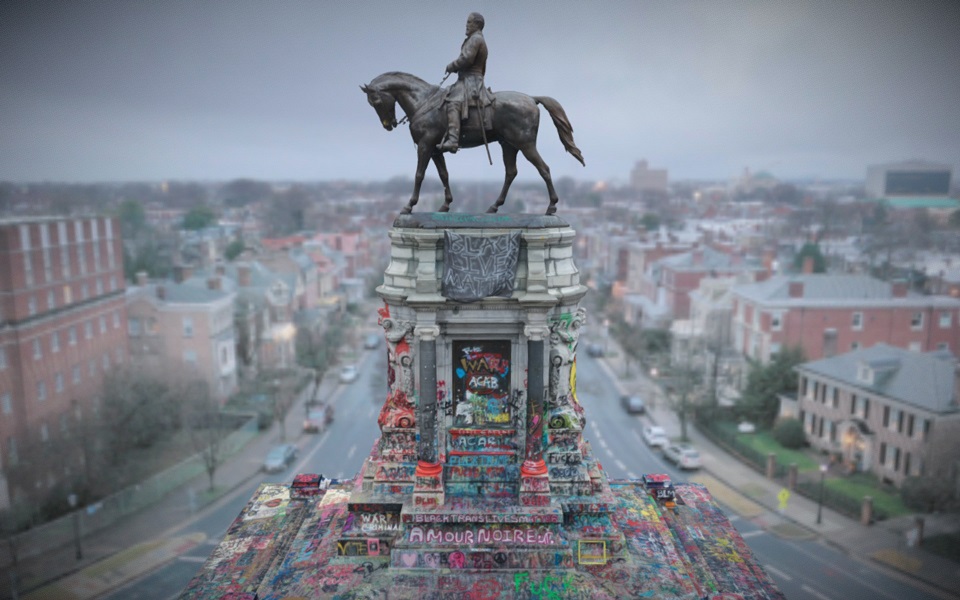
For most of 2021, I worked with The Swiss Federal Institute of Technology, EPFL, in Lausanne, Switzerland, on an exhibit called Deep Fakes: Art And Its Double. We collaborated on an installation called Speaking Back, which showcases two 3D scans, an Aerial 360 Panorama, and an AR experience I captured of the Robert E Lee monument in Richmond, VA. This work took place during city-wide civil rights protests after the killing of George Floyd in 2020. The monument was covered several times with protest graffiti and served as the meeting point for daily marches and demonstrations. Working with historic preservation in my commercial life, I saw what was happening in Richmond as a piece of contemporary history. I felt strongly about documenting it to remind people of the future what this country was going through in 2020.
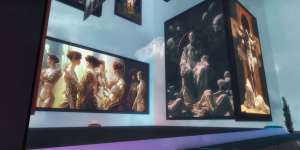
The show opened on September 17th at EPFL Pavilions in Lausanne, Switzerland. The morning after the opening, I got a private tour of the Laboratory for Experimental Museology (eM+). I was nothing short of blown away by how they presented digital archives of history and culture in such a futuristic manner. That pushed me to create forward-thinking presentations for my work, and that rabbit hole led to Somnium Space. For the last month now, I have been adapting to this world and building out a museum based around the Speaking Back installation and some recent scans of the Berlin Wall I captured while in Europe. I view the Lee monument and the Berlin wall as very similar structures in a sense. They were both erected to subdue a portion of the population but were ultimately overtaken and turned into art by the very people they were meant to keep down.

Based on the Lee scans, I am currently working on a series of NFTs that will help fund inner-city STEM education in Richmond. Drones and Photogrammetry will be the main focus of training because this technology will be commonplace in the years ahead. It is essential to train the next generation of technologists today.
What got you into Dev work initially?
I’ve always been a tech-head and involved in art in one form or another. I grew up writing code, and in the late 90s, I was heavily involved in music production. That pushed me to start doing web development to promote my music. A few years later, my audio engineering and web development background led to a job with ASCAP, building out the first generation of Music ID software, similar to Shazam or Soundhound today. Still, back then, we used it to monitor radio airplay for royalty payouts. Shortly after that, I got into Mobile development (iOS) and photography, which ultimately led to today’s work.
What motivated you to go in this direction of development? (scanning or any other skills)
Drones allowed me to create content that had simply never existed before, which I viewed as art. Still, then the tech side of my brain was always thinking of new and exciting ways to present that content, which led me to explore WebVR/XR development. For me, it is always about fusing art and technology to create new immersive experiences that can be shared around the world.
What are the biggest challenges of working on this? (development? format? or scanning?)
The biggest challenge is the diverse skills needed to create these experiences. I tend to work in a bubble by myself after I have my initial vision, so for one person, it can be a real challenge to pick up all the skills needed and execute them on the level required. If I had to do it all over again, I would assemble a team of people to focus on one part, be that design, asset optimization, or development. I’m just thankful that my diverse background gave me enough of a footing to either know how to do what needed to be done or have enough of an idea to figure it out on the fly. However, I feel that will get easier over time as some of these technologies mature more. We are still in the very early days of Web3.0, and it will only get more accessible from here.
What drew you towards blockchain technology as a means of historic preservation?
I have always thought that accessibility and transparency should significantly benefit digitizing the world around us. I have often worked on scanning projects hoping that the museum or institution that owned the objects would share these far and wide with people who can’t witness it otherwise, but that rarely turned out to be the case. Often scans would sit on a hard drive someplace or an obscure web page that no one ever promoted. I believe that moving some of these assets onto the blockchain will give them another level of accessibility from the general public.
Links
- Website: https://terrykilby.com/
- Socials: https://terrykilby.com/link-tree/
- Deep Fakes: https://terrykilby.com/deep-fakes/
- EPFL In Conversation Interview: https://epfl-pavilions.ch/events/deep-fakes-in-conversation-terry-kilby
- Lee Scans: https://sketchfab.com/terrykilby/collections/robert-e-lee-memorial
- Berlin Wall Scans: https://sketchfab.com/terrykilby/collections/berlin-germany
- Lee Animation: https://www.youtube.com/watch?v=HlAqE-d05QE
Leave a Reply